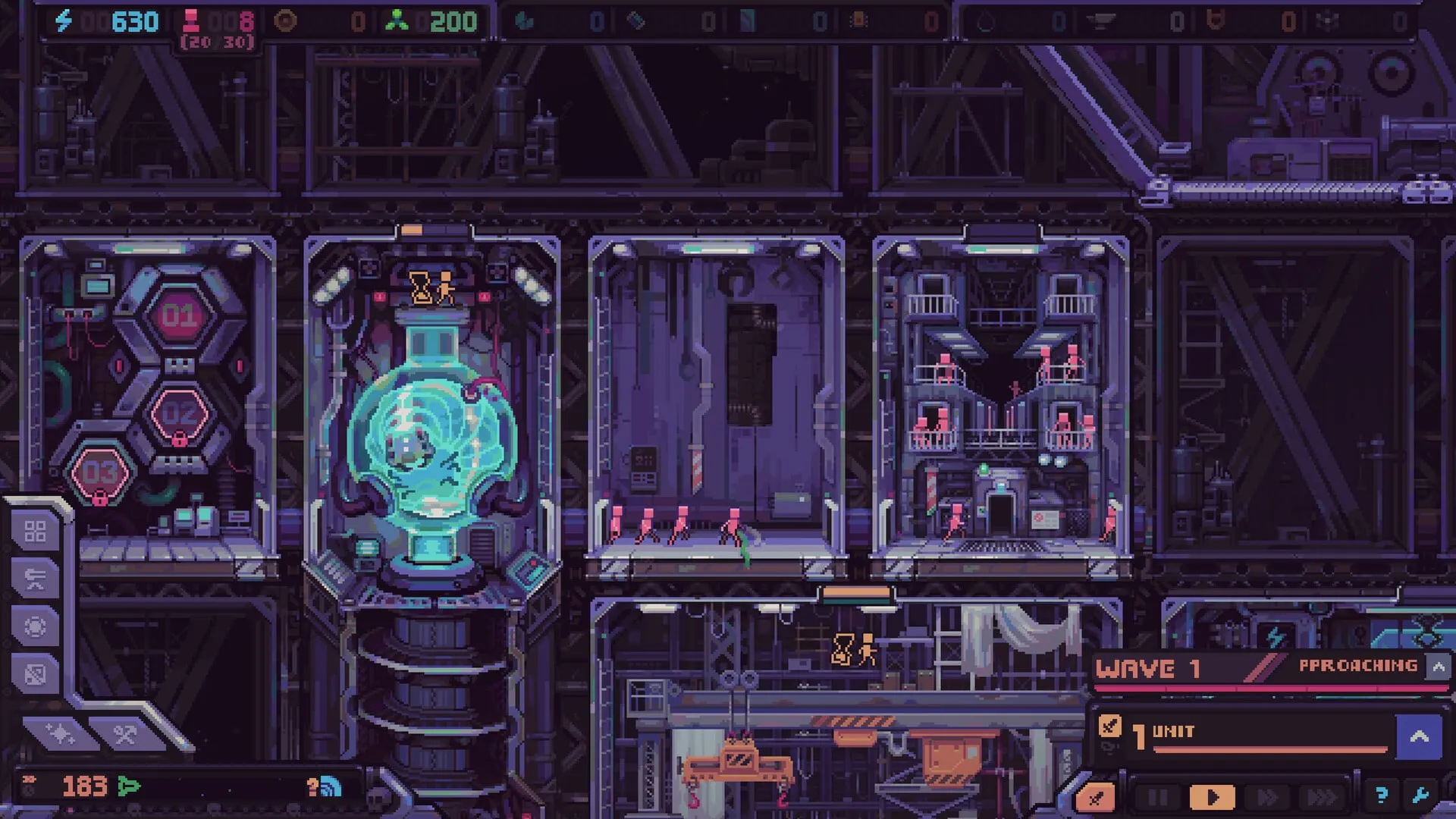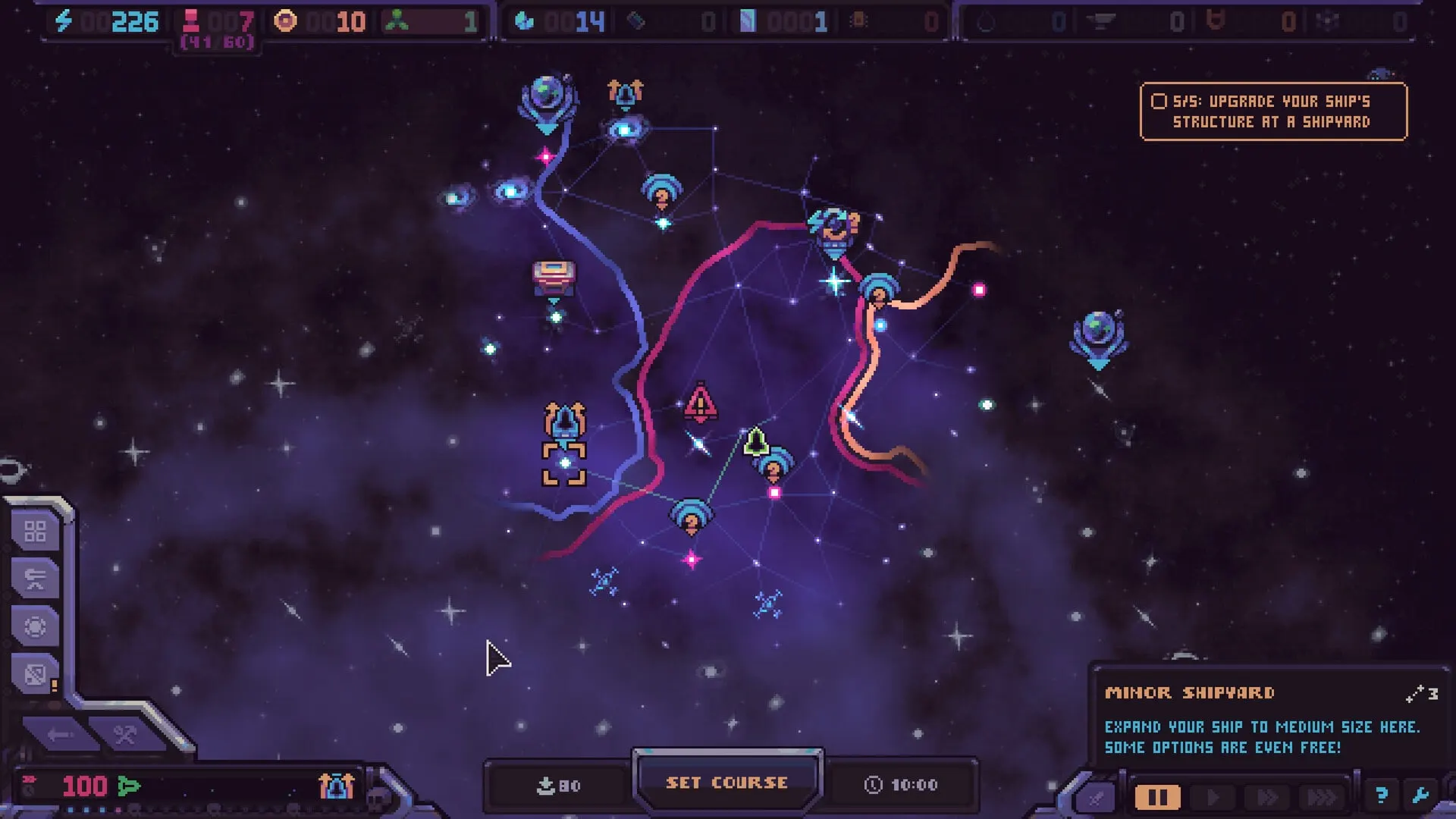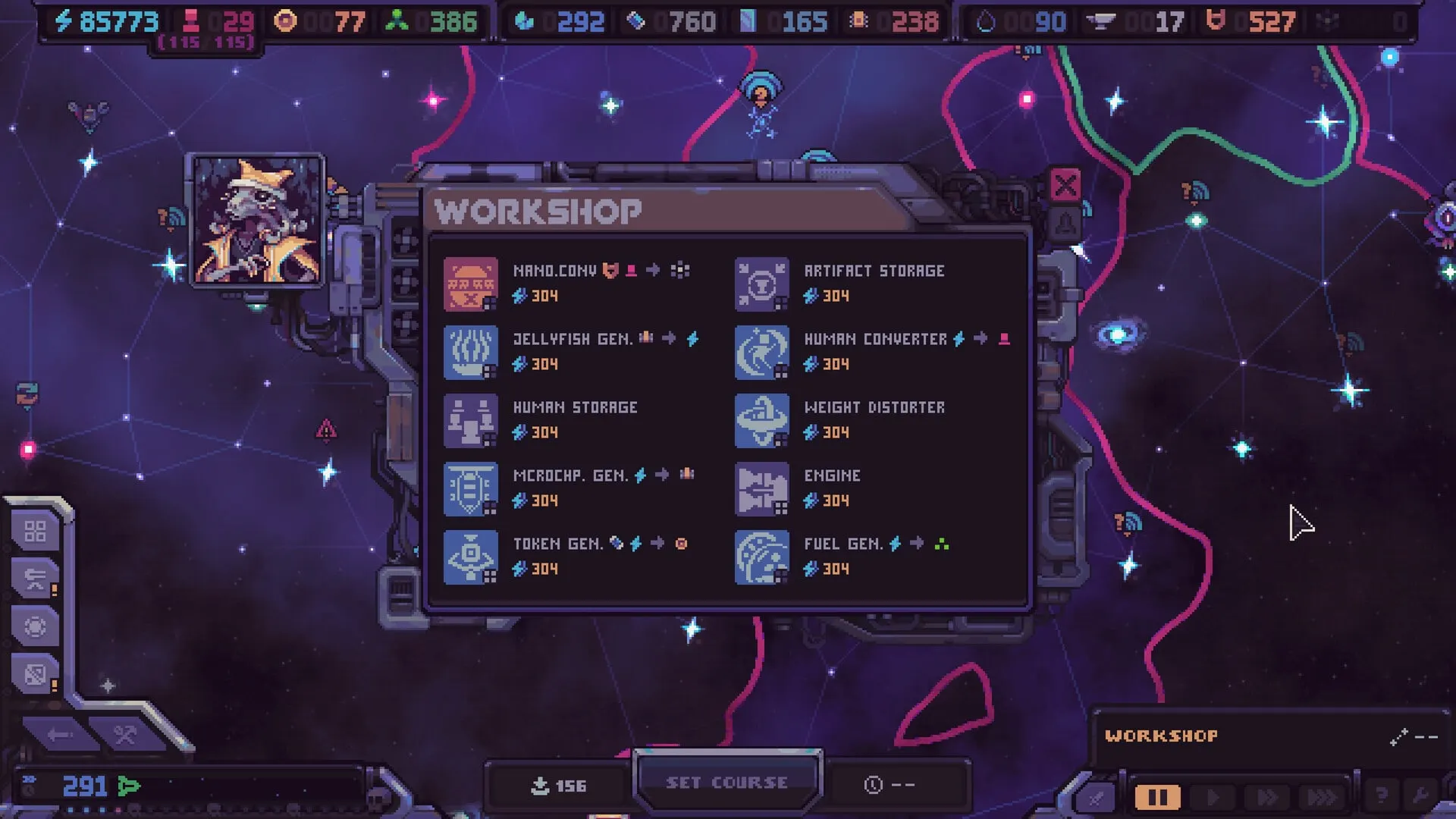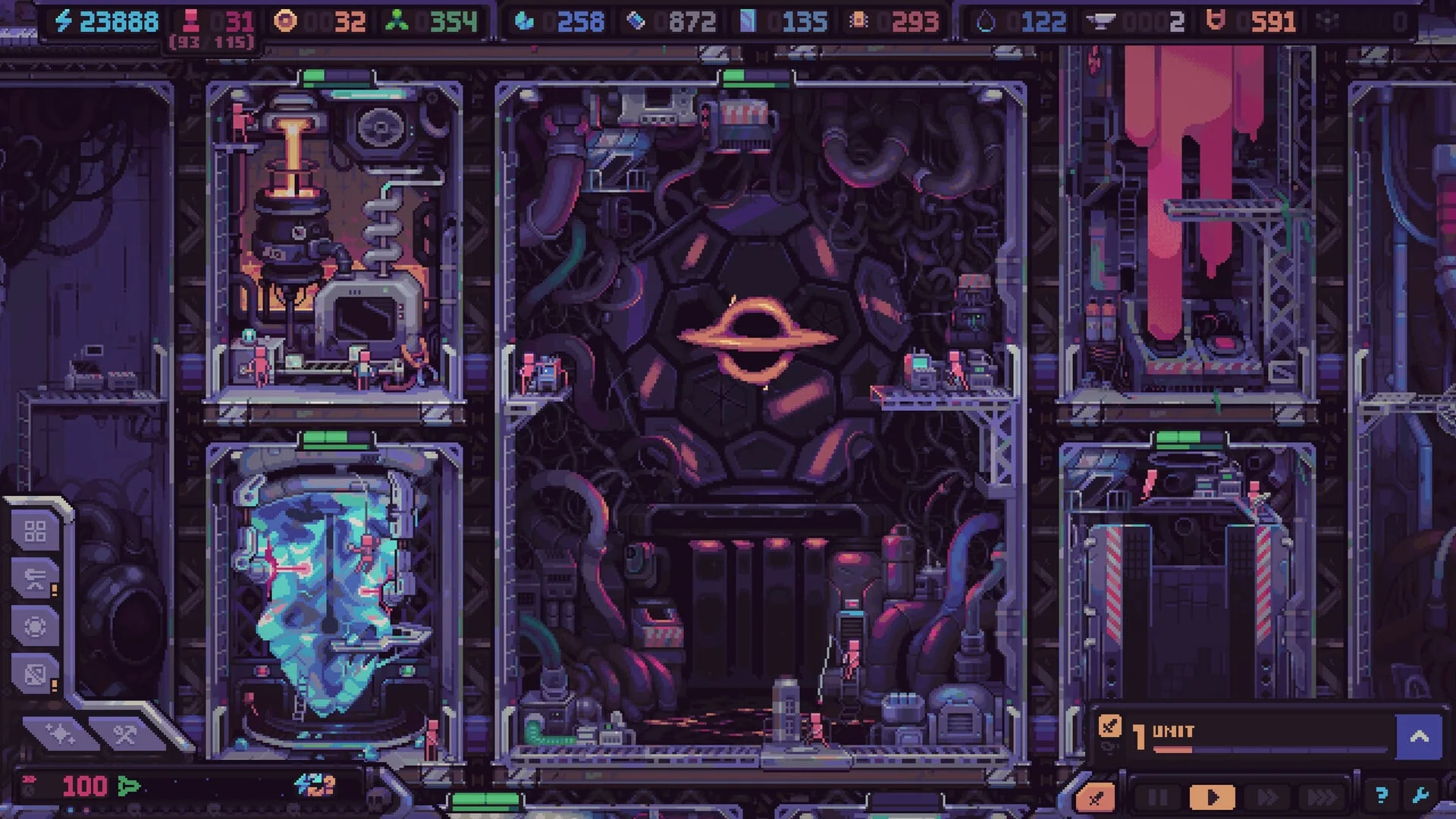
Hull Rupture resources form a set of chains, not a pile of gold. Humans staff rooms, rooms consume inputs, inputs come from other rooms, and every room adds weight and power demand. When production stalls, the cause is almost always upstream or organizational — not a lack of the resource you are staring at.
How the economy actually works
There are three layers. Extraction rooms produce base resources such as energy, fuel, minerals and humans. Conversion rooms turn one resource into another: the Bioreactor turns humans into fuel, the Human Converter processes people into something else, and advanced generators turn lower-tier materials into microchips or nanobots. Support rooms store resources, improve adjacency, reduce weight or produce module kits.
A chain is only as fast as its slowest room. If a converter can process 10 units a minute but its input room produces 3, the converter is not a 10-unit room; it is a 3-unit room with expensive idle time. Building a second converter does not fix that. Building the input does.
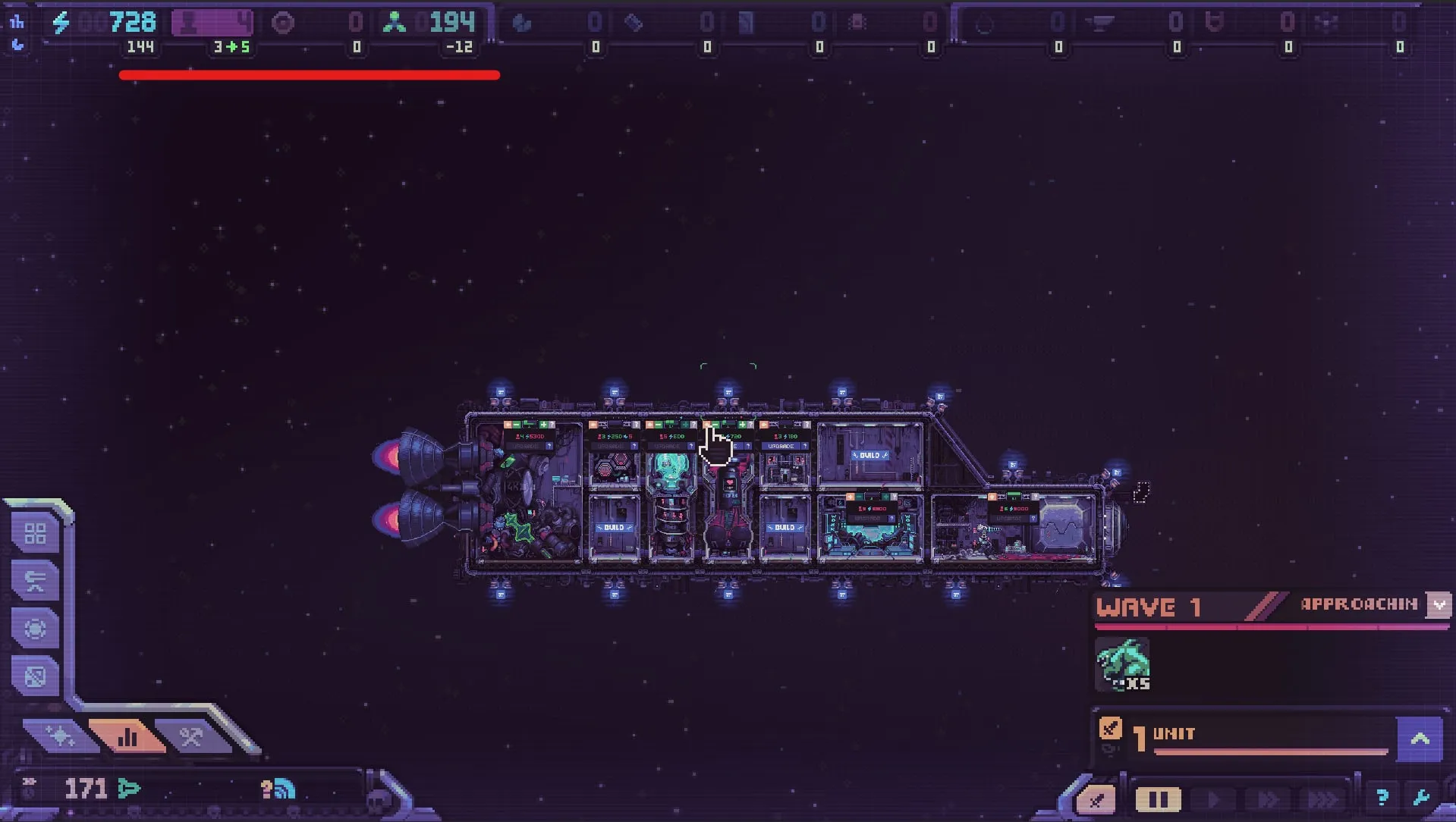
This is why the Income Display added in the September demo matters. It shows current per-minute production, not a forecast. That number is a snapshot of the chain as it is right now: workers assigned, inputs flowing, power stable, storage not capped. If you change one of those conditions, the rate changes. Treat the display as a diagnostic tool, not a guarantee.
Every resource and its job
The resource bar is wider than most new players expect. You do not need to master every icon on day one. You need to know which resources gate the next decision. This table is the working summary; the resource database has the longer notes.
| Resource | Main job | Where it comes from | Priority |
|---|---|---|---|
| Energy | Universal construction and upkeep currency | Human-staffed generators and power modules | Critical |
| Humans | Workforce, converter input and airlock defense | Reproducer modules and events | Critical |
| Tokens | Shop currency | Token Gen. and wave rewards | High |
| Fuel | Keeps engines burning and the ship moving | Fuel Gen. and Bioreactor conversion | Critical |
| Minerals | Base construction material | Mineral Generator, mining events and trade | High |
| Microchips | Advanced module and defense component | Microchip Gen. and event rewards | High |
| Nanobots | Late-game production and repair component | Nano.com module and advanced chains | Medium |
| Plasteel | Later hull construction and advanced structures | Production chains, events and shops | Medium |
| Adamantium | High-tier turret and hull material | Rare production and guarded locations | Medium |
| Mystic Goo | Exotic production input | Mystic Goo Generator and events | Low |
| Biofuel | Organic fuel variant | Bioreactor and biological events | Medium |
| Isotopes | Rare production and event resource | Events and specific modifiers | Low |
Icons are not labels
The top bar shows stock, while Info Mode shows rates. Hover or inspect a resource in-game to confirm its exact role. Several advanced resources share similar icon shapes in the demo UI; do not assume a blueprint’s cost from color alone.
Diagnose a stalled production chain
Work backward from the room that is not producing. Ask these questions in order. The first “no” is your problem.
- Is the module completed and powered? A finished module with no power is a decoration. Check the power overlay and your generator load.
- Are workers assigned? The room needs hands. If the workforce is stretched, production stops before the resource bar tells you.
- Is the input flowing? A converter with no input produces nothing. Trace the input back to its source and check that source’s rate.
- Is the output capped? Storage limits silently waste production. If the storage bar is full, build capacity or spend the resource.
- Is the chain itself the bottleneck? If the input production is lower than the converter’s demand, fix the input before adding more conversion.
- Is the ship too heavy? Mass does not stop production, but it slows travel and can starve you of the events and shops that keep the chain supplied.
This order prevents the classic mistake of building another generator to fix a fuel shortage that is actually caused by an unstaffed bioreactor. The resource bar shows the symptom; the room view shows the cause.
Workforce, storage and the human bottleneck
Humans are the only resource that can work, fight and be converted. That versatility is also the trap. Every human sent to the Bioreactor is a human not staffing a generator, not repairing a module and not holding the Airlock. Converting people is a real strategic choice, not free fuel.
Keep an eye on the human cap. A Reproducer at full storage is wasting output. Build or upgrade Human Storage before the cap, and reassign workers rather than letting rooms sit half-staffed. If the population is growing and your modules are not, you are paying upkeep for unemployed mouths.
The Despot’s Chamber is another workforce sink with a payoff: more humans assigned means more free module kits over time. Staff it when the rest of the ship has spare hands, not when a production chain is already starving. A free kit that arrives while your economy collapses is not free.
The Bioreactor, fuel and the automation trap
The Bioreactor converts humans into fuel. Without fuel, engines lose power and the ship slows; if the ship stops, humanity ends. That makes the Bioreactor look like a machine you should always keep running. It is not.
The September demo added an Auto button to converters, specifically to reduce the clicking around the Bioreactor. It sends two humans into the queue and refills when one remains. That is a quality-of-life feature, not a license to ignore the human cost. If your population is small or your repair crew is already thin, automation can quietly eat the workforce you need for the next wave.
Use Auto when fuel is trending down and humans are abundant. Turn it off when fuel is capped, when a wave is about to hit, or when the next module needs staff. The correct setting changes over a run; the button does not know that.
The fuel spiral
If you add engines to compensate for mass, you increase fuel demand. If you then add a Bioreactor to meet fuel demand, you spend humans. If those humans came from energy production, you may need another generator. This spiral is why expansion should be deliberate. More ship is not always more capacity.
Power, module load and the cost of “one more room”
Energy is the first construction currency and an ongoing upkeep cost. Every module you add increases demand; every hull block you place costs Energy or Plasteel up front. A healthy energy stock can hide a fragile rate. Check the per-minute number before you add a cluster of rooms, especially if you are about to build converters that need continuous power.
Power failure is not always dramatic. Sometimes a module simply runs slower, or a converter waits while another room takes priority. The fix is usually capacity, but not always: if the ship has plenty of generation and still browns out, check that generators are staffed and that their inputs are supplied.
Production priorities by phase
Early game
Stability
- ▸Staff energy generation
- ▸Start human production
- ▸Cover both hull approaches
- ▸Build fuel before engines complain
Mid game
Throughput
- ▸Fix the first stalled input
- ▸Add storage before caps
- ▸Staff the Despot’s Chamber
- ▸Expand for kits you own
Late game
Depth
- ▸Build advanced chains
- ▸Stack debuff support
- ▸Prepare the boss lane
- ▸Keep mass and fuel in balance
Five economy traps that look productive
1. Building downstream before upstream
A second converter on a starved input is a monument to optimism. Fix the input first, then add capacity.
2. Ignoring storage caps
Full storage turns a working chain into an idle one. Build storage before the cap, not after the resource has been wasted for three waves.
3. Treating tokens as a high score
Tokens exist to buy solutions. A large pile while your defense leaks is not wealth; it is a delayed loss.
4. Automating the Bioreactor and forgetting it
Auto keeps the fuel queue running, including when you need those humans elsewhere. Re-check it after every population change.
5. Expanding faster than you can staff
Empty rooms add mass and power demand without output. If you cannot staff the new block, you have built a heavier ship, not a better one.
Hull Rupture production FAQ
Quick answers
Economy questions
How do you increase production in Hull Rupture?
Fix the limiting input first: staff the module, supply its input, confirm power, and check storage caps. Adding another downstream module to a starved chain does not increase output. Info Mode shows current per-minute rates for diagnosis.
What does the Bioreactor do in Hull Rupture?
The Bioreactor converts humans into fuel. The demo added an Auto control that maintains a two-human queue and refills when one remains. Automating it reduces clicking but can drain your workforce if you do not monitor it.
What are tokens used for?
Tokens are the shop currency. They buy themed module and turret boxes after waves, and they can also be used in workshops and markets. Tokens do not substitute for missing production inputs.
Why is my module not producing anything?
Check four things in order: workers assigned, input resource available, power supplied, and output storage not capped. If all four are fine, verify that the module is completed and adjacent to the correct slot.
Should you automate the Bioreactor?
Use Auto when you want a steady trickle of fuel without micromanagement. Turn it off when humans are scarce, when you need workers elsewhere, or when fuel storage is full. Automation is a convenience, not a strategy.
What is the most important resource in Hull Rupture?
Momentum is the real resource. Energy and humans are the most common early bottlenecks, fuel keeps the ship moving, and tokens provide flexibility. Any resource at zero can stop the run if it gates the next upgrade.
Next step
Once the chain is stable, read the shop and module kit guide to turn tokens into the right kind of capacity, then the defense guide to protect it.