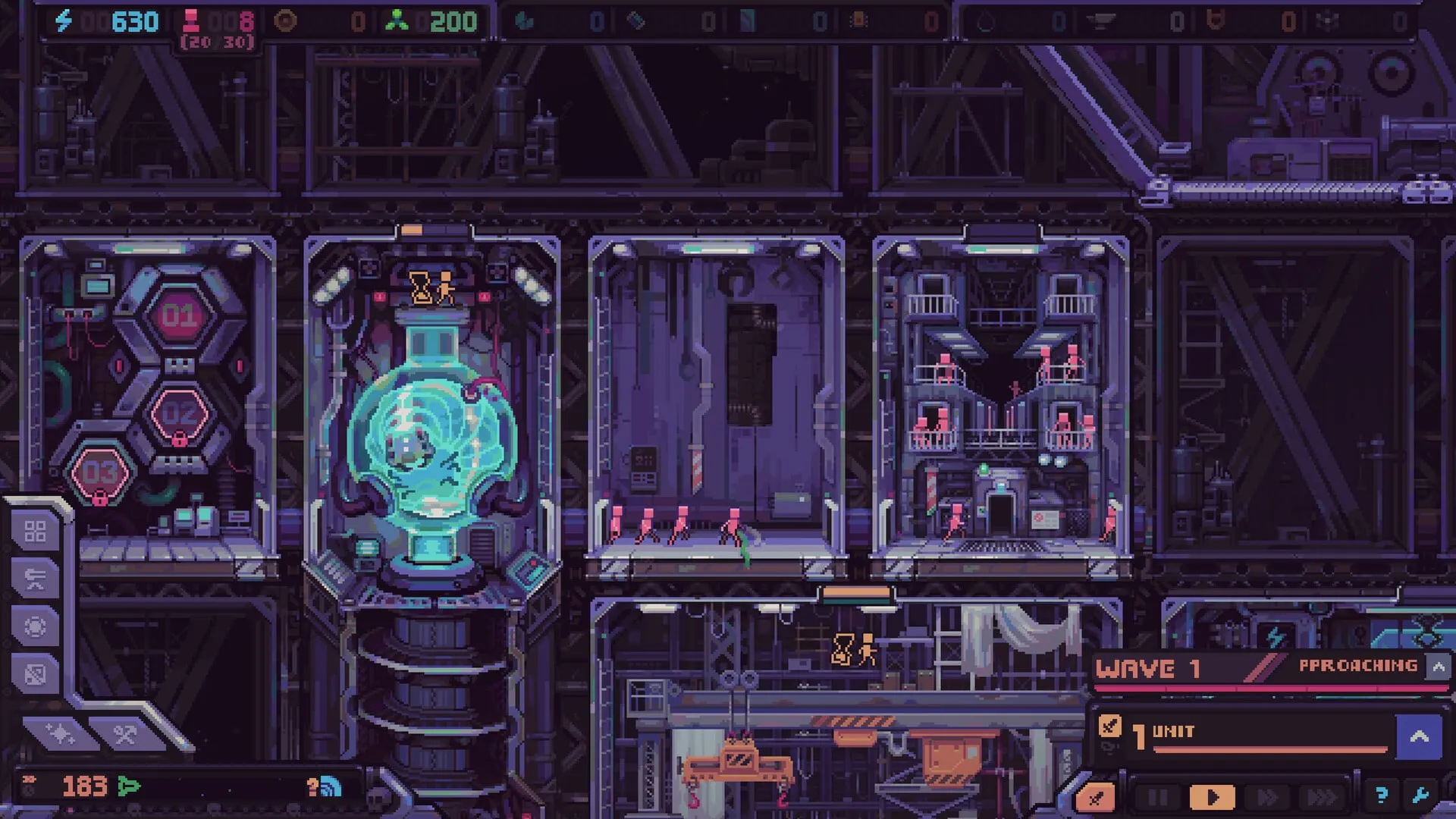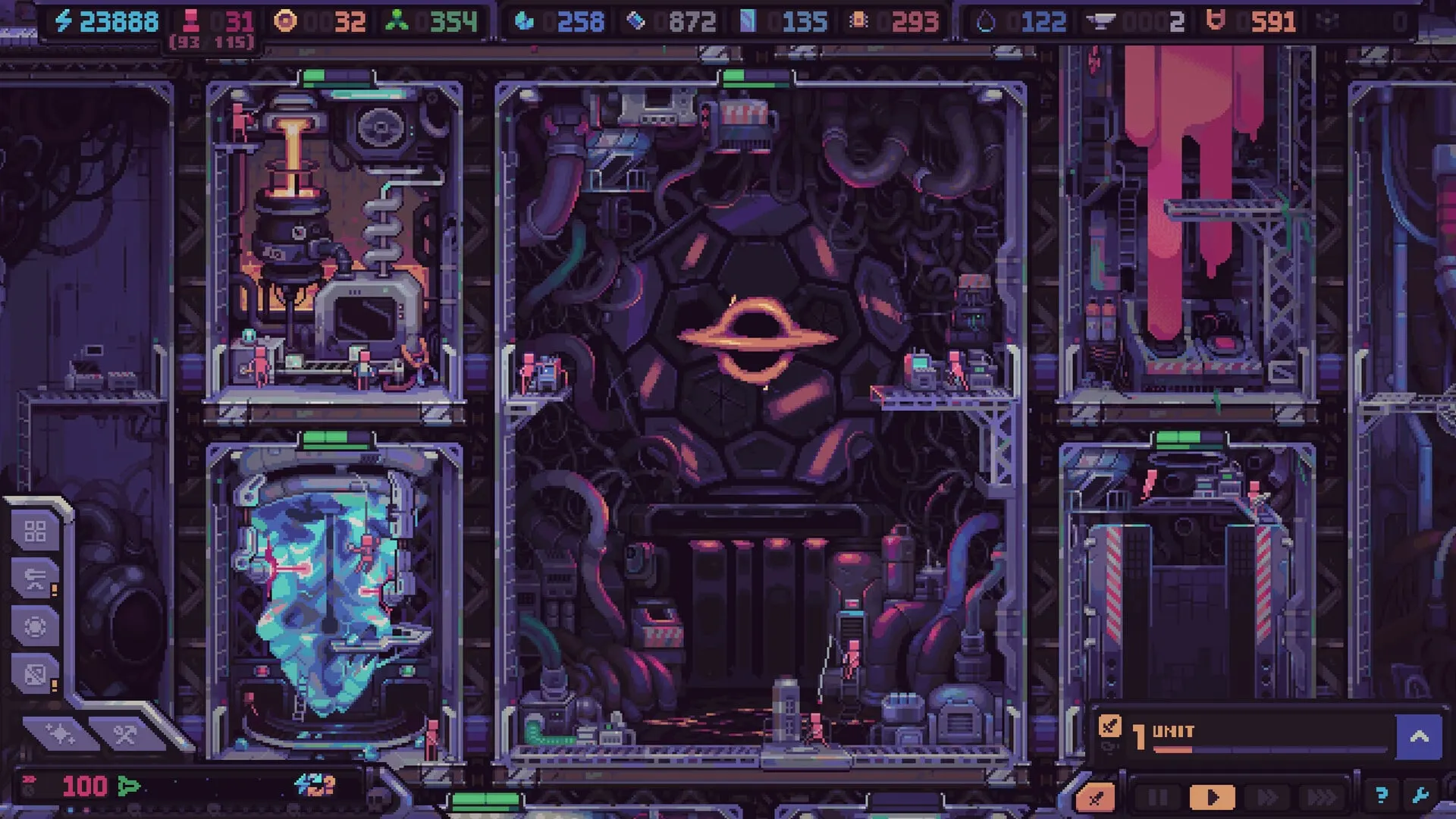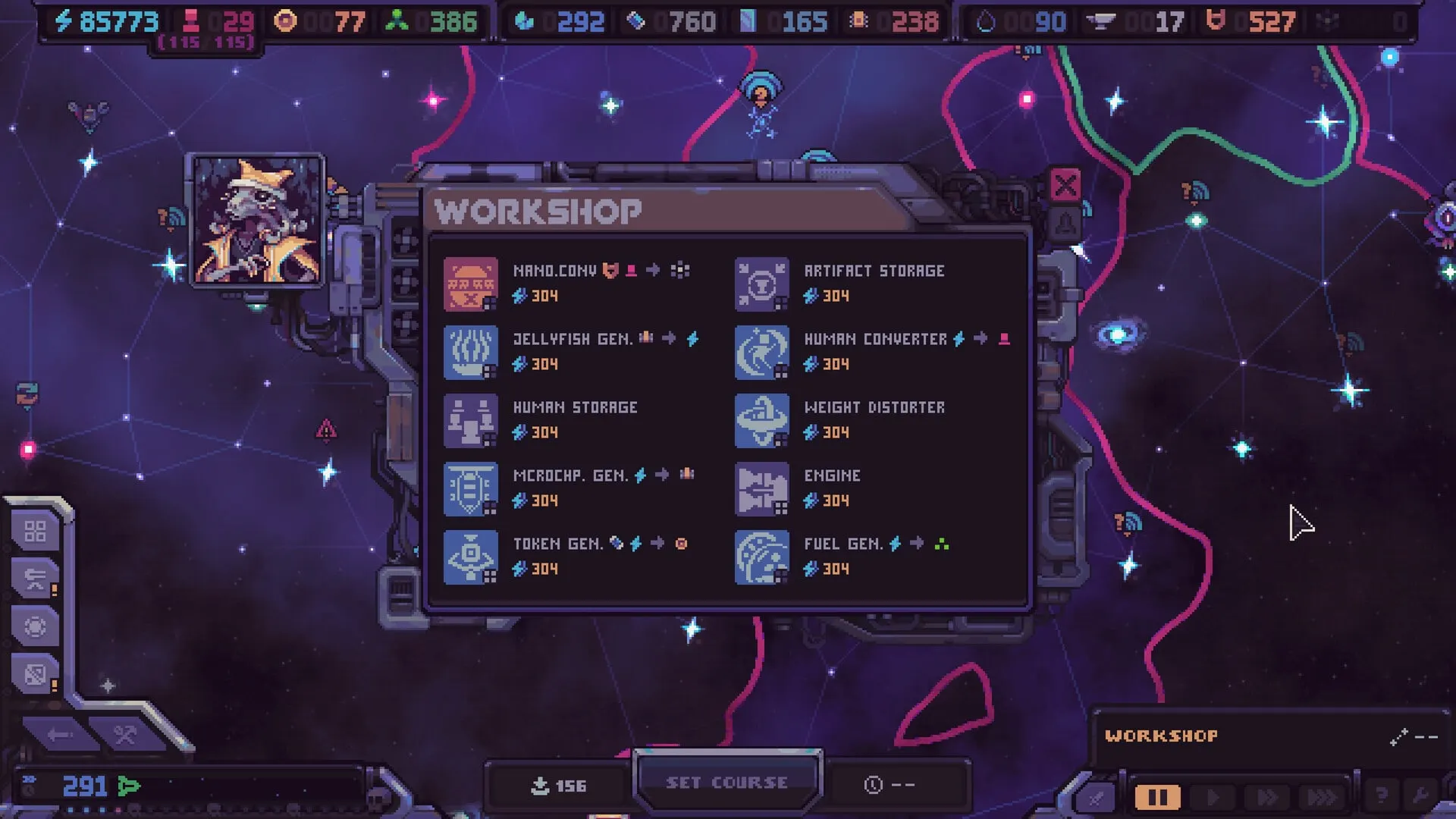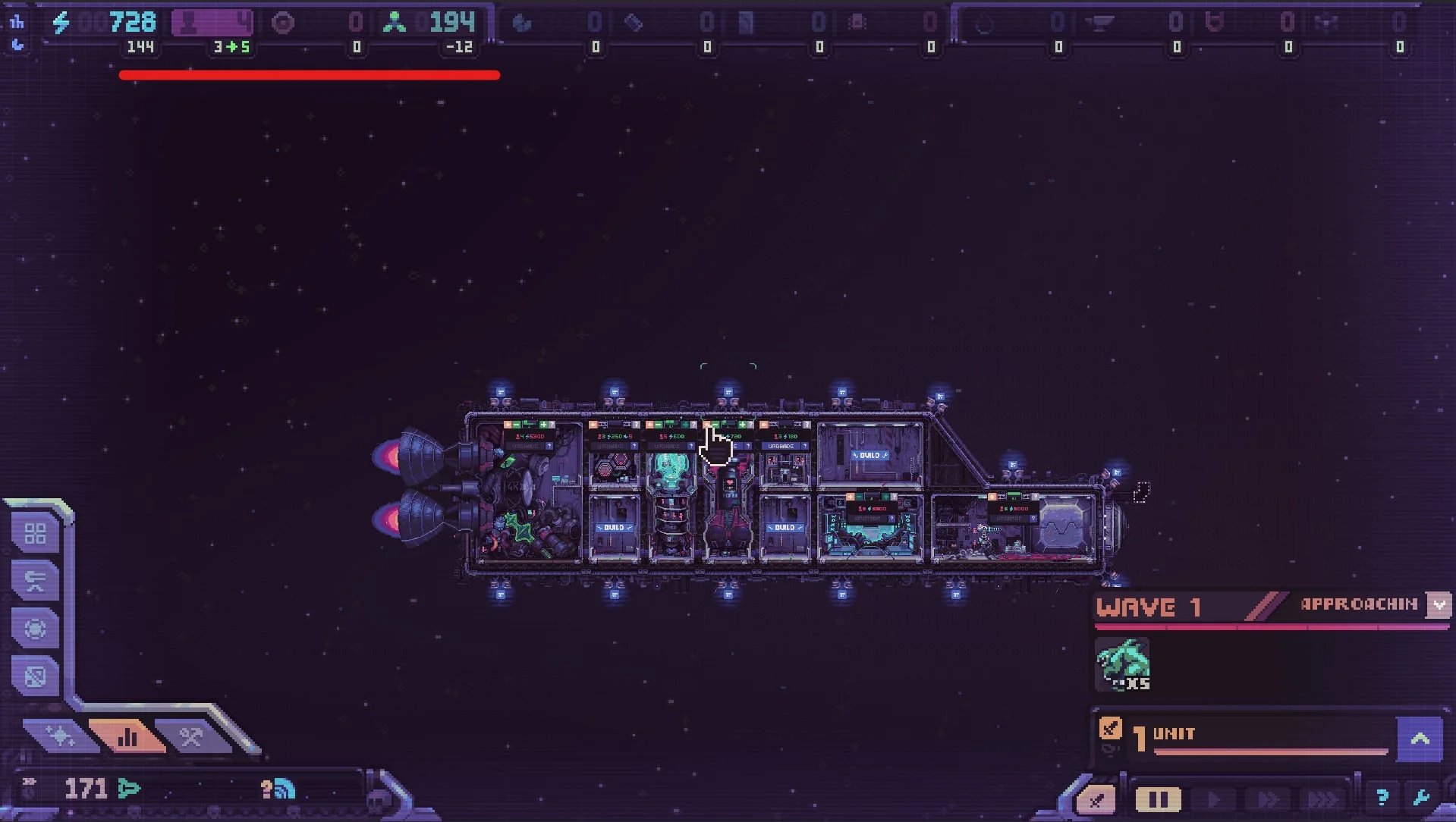
Hull Rupture resources form a chain of dependencies, not a single currency. The game deliberately makes several resources scarce at once so that “what should I build?” always has more than one right answer — and several expensive wrong ones.
Resource overview
The resource bar displays stock, while Info Mode displays current per-minute production. A resource can look healthy in stock and still be collapsing in rate. The priority labels below describe how urgently a shortage usually needs to be addressed, not how rare the resource is.
Critical
Energy, humans, fuel. A shortage can stop the run.
High
Tokens, minerals, microchips. Gate the next upgrade.
Medium
Nanobots, plasteel, adamantium. Gate the late game.
Full resource table
| Resource | Role | Source | Priority | Note |
|---|---|---|---|---|
| Energy | Universal construction and upkeep currency | Human-staffed generators and power modules | Critical | Early hull blocks are paid for with Energy. A brownout stops expansion and repairs. |
| Humans | Workforce, converter input and airlock defense | Reproducer modules and events | Critical | Every human can work, fight or be processed. Capacity is limited by Human Storage. |
| Tokens | Shop currency | Token Gen. and wave rewards | High | Tokens buy post-battle boxes and workshop modules. They cannot solve a missing input. |
| Fuel | Keeps engines burning and the ship moving | Fuel Gen. and Bioreactor conversion | Critical | If fuel collapses, travel slows and route plans collapse with it. |
| Minerals | Base construction material | Mineral Generator, mining events and trade | High | A common bottleneck for mid-run modules and turret upgrades. |
| Microchips | Advanced module and defense component | Microchip Gen. and event rewards | High | The September demo rebalance made Microchips easier to produce but more necessary. |
| Nanobots | Late-game production and repair component | Nano.com module and advanced chains | Medium | Reaching Nanobots opens the top of the tech tree. Do not rush it without inputs. |
| Plasteel | Later hull construction and advanced structures | Production chains, events and shops | Medium | Hull blocks switch from Energy to Plasteel later in a run. |
| Adamantium | High-tier turret and hull material | Rare production and guarded locations | Medium | A strategic scarcity: route toward it only when your build can use it. |
| Mystic Goo | Exotic production input | Mystic Goo Generator and events | Low | Some modifiers, such as mushroom minerals, care about your Goo stock. Check before dumping it. |
| Biofuel | Organic fuel variant | Bioreactor and biological events | Medium | The Bioreactor turns humans into fuel. Automate it carefully, not constantly. |
| Isotopes | Rare production and event resource | Events and specific modifiers | Low | Situational but powerful when an event or modifier turns builds into Isotope income. |
Critical resources: the three that stop runs
Energy
Energy is the first construction currency and the ongoing power supply. Hull blocks cost Energy early, modules need it to operate and repairs consume it. A positive energy stock with a negative rate is the most common pre-collapse signal in the game. If energy is falling, stop adding consumers and check that generators are staffed.
Humans
Humans are workforce, converter input and emergency defense. The population cap is set by Human Storage. A capped Reproducer is wasting its output, and an over-converted workforce can leave modules unstaffed. Humans are the only resource that can be spent three different ways, which makes them the most important allocation decision in the game.
Fuel
Fuel powers the engines. If it runs out, the ship slows, route plans fail and the mission timer becomes a countdown to a worse position. The Bioreactor is the blunt solution, but it consumes humans. Balance fuel production against engine demand and avoid adding engines faster than you can feed them.
Advanced resources: don’t rush the top of the tree
Microchips, nanobots, plasteel and adamantium unlock higher-tier modules, turrets and hull blocks. They are exciting, but they are also the most input-hungry parts of the economy. Building a nanobot chain before your mineral and microchip supply is stable produces an expensive idle room.
Mystic Goo is an exotic input with event and modifier interactions. Some modifiers change behavior based on your Goo stock — the mushroom Mineral modifier, for example, boosts output while Goo is below a threshold. Check the interaction before dumping or hoarding it.
Isotopes are a rare event and modifier resource. They are not a core chain, but a modifier that turns small module construction into Isotope income can be run-defining.
Why humans are not just another resource
The game’s pitch treats humans as fuel, but mechanically they are the only resource that performs labor. That makes them a flow, not a stock. A large population is useful only if it is assigned; an assigned population is useful only if its modules have inputs and power. Converting humans for fuel trades future labor for present momentum, which is sometimes correct and often a spiral.
The Bioreactor’s Auto control makes the conversion easy to forget. Check it after every population change, especially before a wave when you may need hands for repairs or the Airlock.
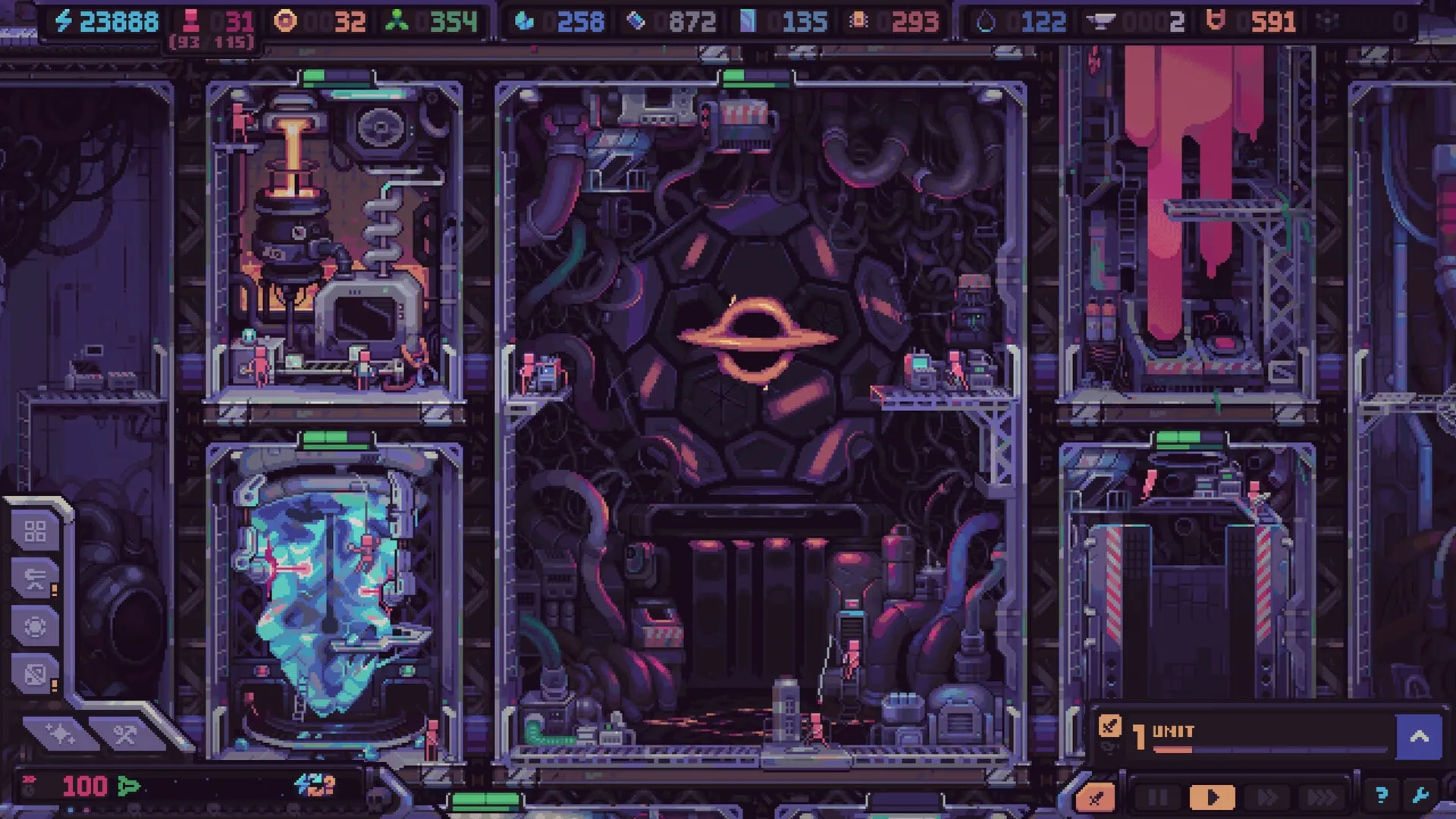
How to read the resource bar
- Scan for zeroes. A critical resource at zero is an emergency; a rare resource at zero is often fine.
- Open Info Mode. Compare stock with per-minute rate. Falling stock plus low rate is the real warning.
- Check the input chain. The resource that is falling may be downstream of the actual problem.
- Check storage. A full bar is not always good news; it may mean output is being wasted.
- Check the next purchase. If the shop option needs a resource you do not produce, it is not a solution yet.
No official recipe database yet
Exact production ratios, recipes and storage caps are not published. This page describes confirmed roles and interactions, not hidden numbers. Use the in-game tooltip before committing a scarce resource.
Next step
Read the production guide for a diagnosis order, or the module database to see which room produces each resource.